
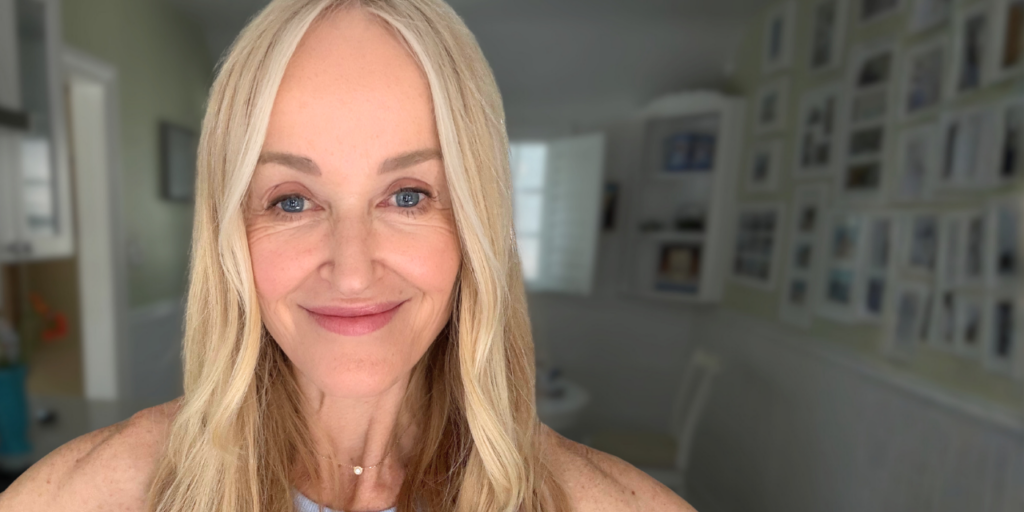

Welcome to the Beauty section of my Journal, where I share evidence-based skincare, makeup, and clean beauty recommendations for women over 50. My goal isn’t to help you look younger—it’s to help you feel confident, radiant, and informed as your skin changes through midlife and beyond.
If your skin feels drier, more sensitive, thinner, or just… different after 50, you’re not imagining it. Hormonal changes, moisture loss, and years of accumulated sun exposure all begin to show up differently in midlife. The good news? You don’t need a complicated 12-step routine or expensive treatments to support your skin. You simply need to understand what your skin needs now.
👉 Watch the full video here
One of the biggest misconceptions about skincare after 50 is that we should be trying to look younger. Personally, I don’t believe that’s the goal. The goal is healthy, radiant skin that reflects how you want to show up in this season of life. Skin that feels good. Skin that functions well. Skin that is supported from the inside out.
Understanding Your Skin After 50
As estrogen declines, our skin naturally becomes:
- Drier
- Thinner
- More sensitive
- Slower to renew itself
- More prone to pigmentation and redness
One of the biggest takeaways from the research is that moisture matters far more than most people realize.
In fact, studies have shown that improving skin hydration can visibly reduce the appearance of wrinkle depth. Not because you’re “filling in” wrinkles, but because well-hydrated skin appears smoother, healthier, and more resilient.
This is one reason I place so much emphasis on supporting the skin barrier and protecting moisture levels after 50.
What Does “Clean Beauty” Actually Mean?
I’ve been working in the clean beauty space since my New York Times bestselling book Gorgeously Green was published.
But let’s clear up a common misconception.
Natural does not automatically mean safe.
Synthetic does not automatically mean harmful.
For example, Vitamin C is synthesized in a lab and is one of the most effective skincare ingredients available.
What I focus on is choosing products that are as clean and non-toxic as possible while still being effective.
We are exposed to thousands of chemicals in daily life. This is often referred to as our body burden. We can’t avoid everything, but what we put on our skin is one area where we can make thoughtful choices.
If there is one ingredient category I recommend avoiding, it’s synthetic fragrance (sometimes listed simply as “fragrance” or “parfum”). These formulas can contain phthalates and other ingredients that manufacturers aren’t required to disclose.
💛 I’ve created a free Sophie’s Picks Skincare Guide with my favorite skincare, makeup, sunscreen, and clean beauty recommendations, plus ingredients I recommend avoiding.
My Two Non-Negotiables for Healthy Skin After 50
If I had to simplify skincare down to two things, they would be:
1. Sunscreen
Sunscreen is the most powerful anti-aging tool we have.
Look for a broad-spectrum mineral sunscreen containing zinc oxide and/or titanium dioxide. Consistency matters far more than chasing the highest SPF number.
2. Double Cleansing
Every evening, I recommend a double cleanse.
The first cleanse removes sunscreen, makeup, and pollution. The second cleanse cleans the skin itself.
This simple habit can make a tremendous difference in how your skin looks and feels over time.
My Morning Skincare Routine
Vitamin C
Vitamin C helps support collagen production, brighten the complexion, and provide antioxidant protection.
A quick tip: check the little jar symbol on the packaging. It often says something like “6M” or “12M,” which means the product should be used within six or twelve months of opening.
If your Vitamin C serum turns dark yellow, orange, or brown, it’s oxidized and should be replaced.
Ceramides
You’ll hear me talk about ceramides a lot.
Ceramides are naturally occurring fats in the skin that help hold skin cells together. Think of them as the glue that supports your skin barrier.
As we age, we naturally lose ceramides, making it harder for our skin to retain moisture.
That’s why I love moisturizers that contain ceramides. They help support hydration, reduce sensitivity, and strengthen the skin barrier.
Finish with Sunscreen
Always finish your morning routine with sunscreen.
Every day.
Even when it’s cloudy.
My Evening Skincare Routine
Step 1: Double Cleanse
Start by removing makeup, sunscreen, and environmental debris with an oil or balm cleanser, followed by a gentle water-based cleanser.
Step 2: Retinol
Retinol is one of the most researched ingredients in skincare.
It is a derivative of Vitamin A and can help:
- Improve skin texture
- Support collagen production
- Reduce the appearance of fine lines
- Improve pigmentation
- Encourage healthier skin cell turnover
For most women, a gentle over-the-counter retinol is a wonderful place to start.
If you’re new to retinol, begin with a low concentration and use it only two nights per week before gradually increasing frequency.
After your retinol has absorbed, apply a nourishing moisturizer—especially one that contains ceramides and barrier-supportive ingredients.
Remember: after 50, healthy skin is often more about hydration than aggression.
What About Bakuchiol?
If your skin is very sensitive or you prefer a plant-based option, bakuchiol may be worth considering.
Bakuchiol is derived from the babchi plant and has become a popular alternative to retinol. While it doesn’t work exactly the same way, it may offer some similar benefits with less irritation.
What About Peels, Acids, and Masks?
This is where many women accidentally overdo it.
Ingredients like glycolic acid, salicylic acid, and other exfoliating acids can help improve texture and brightness, but they can also increase irritation—especially in mature skin.
If you choose to use them, use them sparingly and never on the same night as retinol.
Personally, I prefer gentle enzyme masks. They offer mild exfoliation with far less irritation and can be a lovely monthly ritual.
As for sheet masks? They’re fun, relaxing, and my daughter and I occasionally enjoy them together. But there isn’t strong evidence that they deliver ingredients more effectively than a good serum or moisturizer.
Think of them as a treat, not a necessity.
The Bottom Line
After 50, skincare doesn’t need to be complicated.
Focus on:
- Sunscreen
- Gentle cleansing
- Moisture
- Barrier support
- Consistency
The goal isn’t perfection.
The goal is healthy, radiant skin that helps you feel confident and comfortable in your own skin.
Free Sophie’s Picks Skincare Guide
If you’d like all of my favorite skincare, sunscreen, makeup, and clean beauty recommendations in one place, I’ve put together a free guide for you.
👉 Download Sophie’s Picks Skincare Guide
And if you haven’t already watched the full episode:
👉 Don’t forget to watch the full video here.
Take care of your skin—it’s the only one you’ve got. 💛